

Tamiya
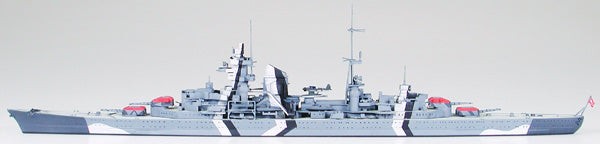
Tamiya German Heavy Cruiser Prinz Eugen
Tamiya German Heavy Cruiser Prinz Eugen
Couldn't load pickup availability
Basic information
| Product code | tam31805 |
| Weight: | 0.22 kg |
| Ean: | 4950344999484 |
| Scale | 1:700 |
| Size | 303 x 31 mm |
| Paint | X-10,XF-1,XF-2,XF-23,XF-24,XF-26,XF-52,XF-54,XF-55,XF-56,XF-64,XF-65,XF-7, |
| Added to catalog on: | 11.4.2005 |
| Tags: | Prinz-Eugen |
| Manufacturer | Tamiya, INC 3-7 Ondawara 422-8610 Suruga-Ku, Shizuoka Japan |
| Responsible entity | HIT-BIS Spółka z o.o. Zwycięzców 6A/4 03-941 Warszawa Poland |
Prinz Eugen was a German heavy cruiser, the keel of which was laid in 1936 and launched in August 1938. The cruiser entered the rope service of the German Navy (German Kriegsmarine) in August 1940. The ship was 213 meters long, 21.8 meters wide, and had a full displacement of 19,600 tons. Prinz Eugen's top speed was around 33-34 knots. The main armament was 8 203 mm guns in four twin turrets, and the secondary armament included: 12 105 mm guns or 17 40 mm cannons.
Prinz Eugen was the third Admiral Hipper class warship. Cruisers of this type were ordered in order to significantly strengthen the Kriegsmarine's heavy forces. They emphasized the greatest possible autonomy, and the artillery armament was rather typical of heavy cruisers of the late 1930s. Prinz Eugen's combat career began with her participation in Operation Rheinubung with the battleship Bismarck in May 1941, which led to the sinking of the British battleship HMS Hood and the German battleship. Prinz Eugen, on the other hand, suffered serious damage and was forced to return to the port of Brest. There, in July of the same year, it was damaged in an air raid conducted by the British RAF. In February 1942, together with Scharnhorst and Gneisenau, she was ferry from Berest to Kiel (Operation Cerberus). In the years 1942-1943, it served primarily in the Baltic Sea as a school unit, and in 1944 it was transferred to Finland. Later, in 1944-1945, he supported the operations of German land forces over the Baltic Sea, especially in Courland and East Prussia. In May 1945, it was handed over to the British, and later it ended up in the hands of the Americans, who used it for nuclear weapons tests at Bikini Atoll in 1946.
Share